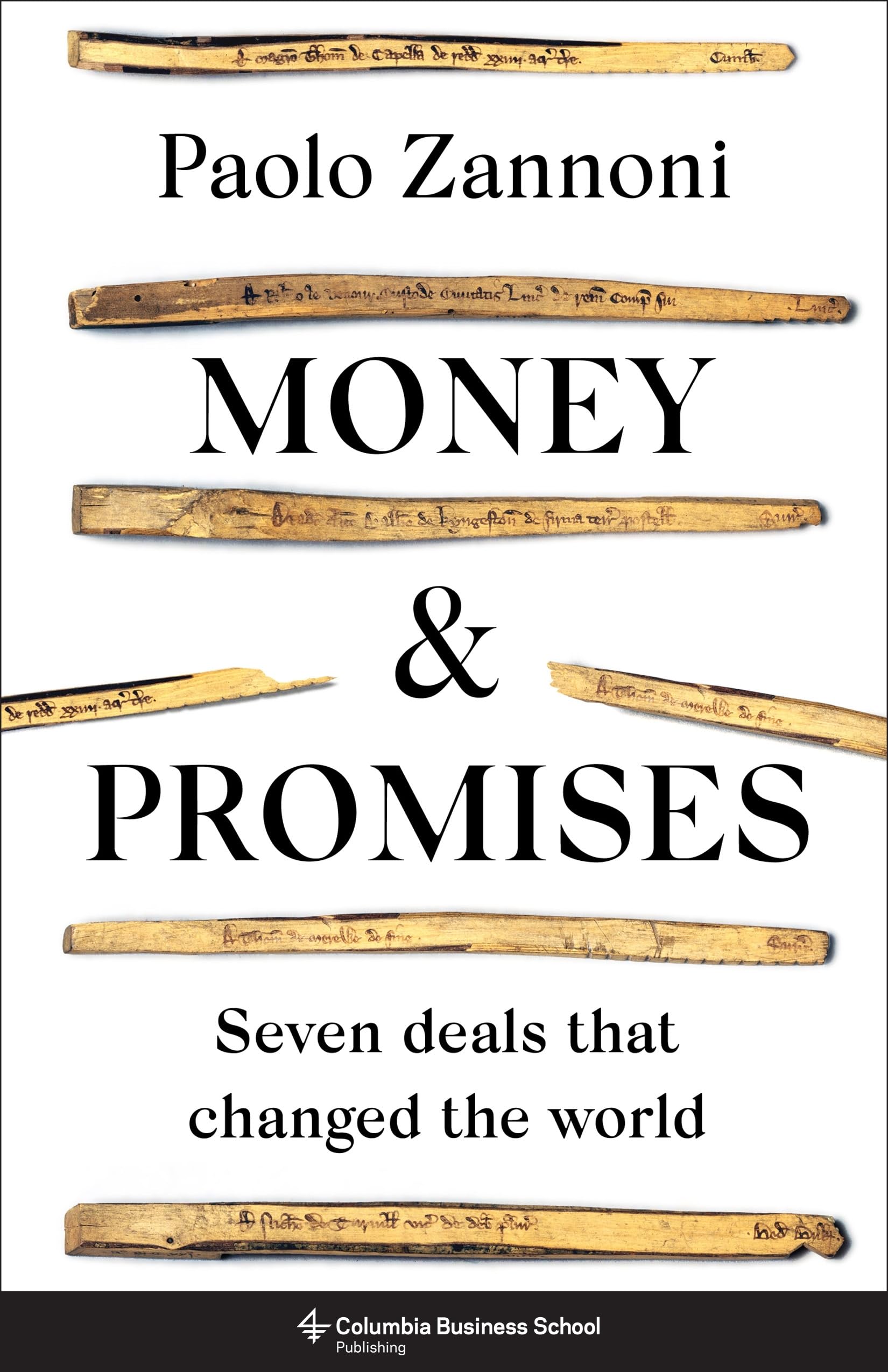
Review of Money and Promises
By Paolo Zannoni
Columbia Business School Publishing
Review by Adam Stone
Global Insights Review
Money and Promises offers a historical account as to how the modern underpinning of banking, the usage of money that doesn’t truly exist came about. Zannoni a distinguished banker, follows seven deals which foundationally changes banking and the world. The first segment of the book focus on the Italian city state of Pisa, an economy entirely reliant on trade and merchants to keep their governments afloat. However, this created a problem as merchants would sell their goods for coin and then quickly leave the city to buy more products to move. Thus, precious metals would leave as soon as they entered. To continue payments once the city couldn’t utilize hard currencies, a series of debt obligations were given between merchants and the banks of Pisa. These ledgers could then be utilized by the banks to pay its debts with the promises of its own debtors, fundamentally changing banks in the 1200’s from places which could store money and lend only what they had, to lenders of debt. Likewise, the Venetians created a series of banknotes to address their geopolitical conflicts in the early 1600’s, where they could not directly pay for ships to protect their nation’s survival they would raise funds via banknotes abroad. They did this by employing ship owners in Holland and England and paying them through local financiers who would pay for the ships and crews. Then Venetian officials in Holland and England could use their venetian banknotes to settle the debt in Venice, buying a fleet of ships without coins. Likewise early banking in revolutionary United States through the 1770’s and British tally system allowed for the creation of state and private wealth with the greater acceptance of debt as a currency in lieu of currency with inherit value. Other monetary developments covered in “Money and Promises” included the adaptation of banks to avoid Usury in Naples, development of currency in Communist Russia and the Écu de Marc, the first international currency. All seven stories come together to tell the story of debt and its importance in creation of the modern economy. The book does an excellent job of explaining complex ledger systems, how their foundations were for the most part natural systematic risks of their respective economies, while innovative thinkers were able to trailblaze for their own gain, creating the modern corporate banking. Where the book falls a bit short is in it contextualization of each development to each other. The seven banking events feel like isolated events even when they created significant change in the world. Thus, it reads like seven short stories tied loosely together. Additionally, there is little that directly ties any of the events to modern day banking, the read is left to use their own understanding of global finance to make inferences as to where these connections lie. A final chapter that walked the reader through each development and what it looks like today would elevate this history book to one that would be essential for every finance student.
Final Grade 3.75/5
 Global Insight Reveiw